
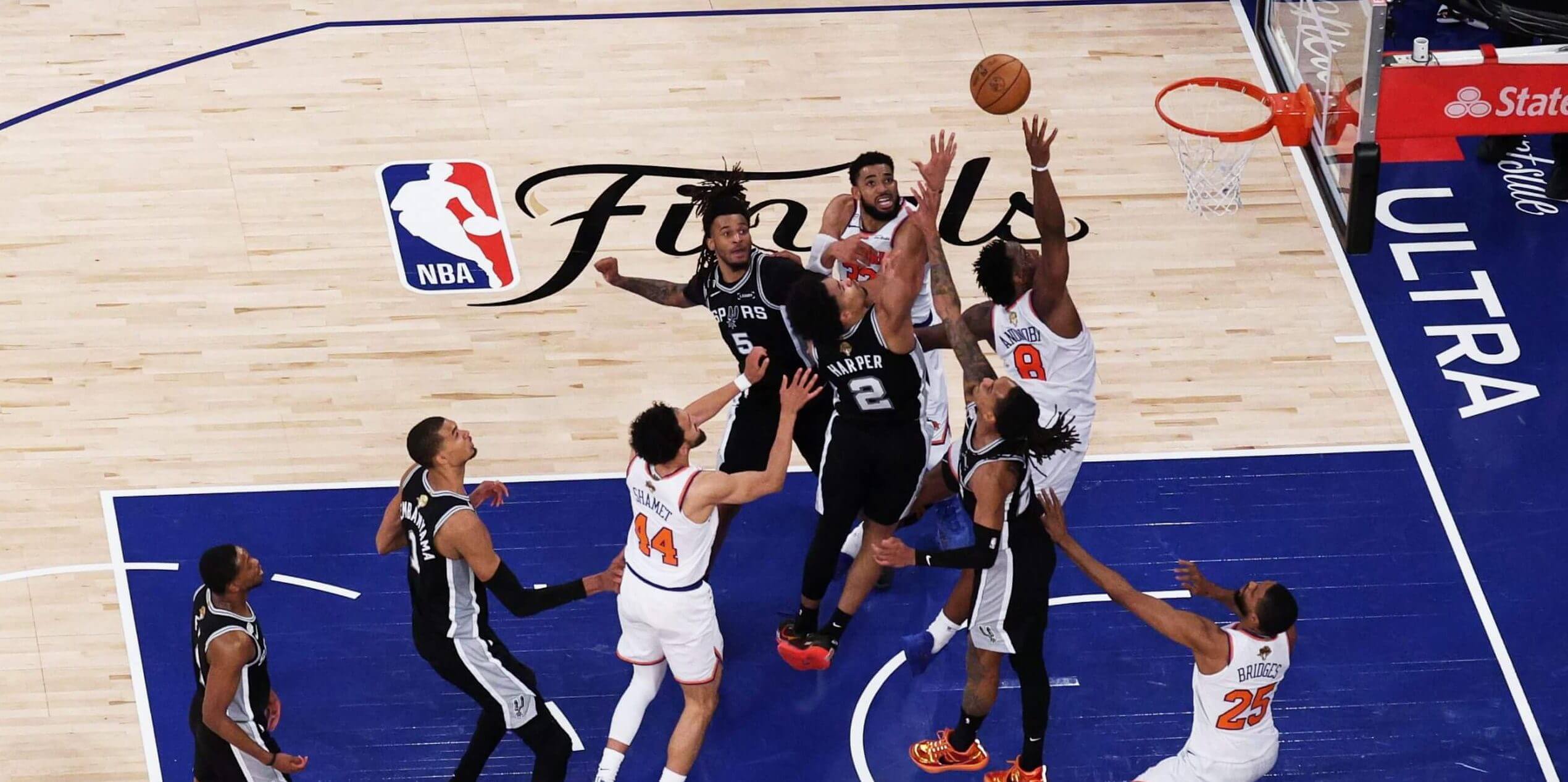
On Saturday night in San Antonio, in the arena of the team that held home-court advantage over them, the New York Knicks ended fifty-three years of waiting. The final was 94-90, Game 5, a 4-1 series victory — sealed not at Madison Square Garden but on the road, with Knicks fans audible in the Spurs' own building as the clock expired. It was the franchise's first championship since 1973.
They did not arrive the way recent champions do — loaded with lottery picks and patiently assembled through the draft, the blueprint that has produced nearly every modern title team. Oklahoma City won that way in 2025; Boston in 2024. The Knicks, under team president Leon Rose, Finals MVP Jalen Brunson, and a coach in his first year on the job, built something the league's prevailing wisdom did not recognize as a champion — then won three of their four games in San Antonio, rallying from a double-digit deficit in every one.
It’s more than a basketball story. It’s a case study in how conventional wisdom consistently undervalues the qualities that actually decide who wins — in sports, in business, and in the competition for talent that defines both.
The Market Was Wrong
Before a single game this season, oddsmakers installed the Spurs at 65-1 to win the title. The figure is worth sitting with — not because it insulted San Antonio, who went on to a 62-20 record and home-court advantage in the Finals, but because of how completely it missed.
This is a failure mode every founder has encountered. Venture capital is, at its core, a pattern-matching enterprise: investors observe what produced returns last cycle and allocate toward whatever resembles it. After Oklahoma City's draft-built title and Boston's meticulously assembled core, the conventional wisdom calcified into patience, ping-pong balls, and player development. Anything else was improvisation dressed up as strategy.
The Knicks were unimpressed. When a market holds strong convictions about how something is supposed to work, it becomes structurally incapable of pricing what doesn't fit the template — and the gap between what the market believes and what is actually true is precisely where durable advantage is built. The Knicks found that gap and exploited it on the sport's largest stage. The best startups do the same thing every day; most don't realize that's what they're doing.
Bet on Character, Not Pedigree
Consider this roster with the dispassion of an analyst. Only two players in the Knicks' rotation were drafted by the organization. The rest arrived via trade — players their previous teams had quietly decided were movable. OG Anunoby spent years in Toronto trade rumors before Rose acquired him; Josh Hart had passed through three franchises before reuniting with his college teammate Brunson. These are not the résumés of championship mythology.
And Brunson himself is a 6-foot-2 guard, the draft process undervalued entirely. On Saturday night he scored 45 points, including 13 straight in the fourth quarter, breaking a franchise Finals record that had stood since Willis Reed set it in 1970. He is now a Finals MVP. The scouts who passed would prefer not to be reminded.
Rose wasn't ignoring talent evaluation; he was doing a more rigorous version of it. Rather than optimizing for ceiling and projected growth curves, he underwrote for qualities the market chronically discounts — fit, character, and the capacity to perform when the moment is largest — none of which appear cleanly in the data.
The parallel for founders is uncomfortably direct. Your best hires are rarely the candidates fielding the most competing offers. They're the ones a larger company overlooked because their contribution didn't map onto an existing role, who built something real and unglamorous somewhere no one has heard of, or simply cared more about the work than the prestige beside their name. Capital markets are extraordinarily efficient at pricing pedigree. They remain, profitably for the contrarian, quite bad at pricing character.
Possession Over Outcome
Three nights before they clinched, the Knicks trailed by 29 points in Game 4. By any conventional measure the game was over, and most teams in that position begin the quiet process of conceding the night.
The Knicks won it, 107-106, on an Anunoby tip-in with 1.2 seconds left — the largest comeback in NBA Finals history.
The explanation came in the language coach Mike Brown used all season. His phrase — repeated in film sessions, timeouts, and the quiet conversations that shape a team's identity — was possession over outcome: don't play the scoreboard, don't calculate the series, don't let the deficit occupy the space that belongs to the next play. Execute the possession in front of you, then the one after that. Hired only a year ago, Brown is the 24th man to coach the franchise since 1973 — and the first to bring the title back.
For anyone who has built a company, this isn't a coaching philosophy. It's a survival manual. Companies come apart under pressure — a collapsed round, a well-funded competitor, a quarter that closes below plan — almost invariably because leadership has raced past the present to the outcome. The spiral begins in the mind before it shows up in the metrics. The antidote is process: trust how you work when the scoreboard turns unreliable, operate at the level of the next decision, and refuse to let a single bad outcome become a referendum on the whole enterprise. It is one possession. Win the next one. This wasn't a one-night conviction, either — the Knicks rallied from a double-digit deficit in all four of their wins, including 16 down in the clincher.
What the Market Missed
It resolves to a single uncomfortable conclusion for anyone whose decisions lean on conventional wisdom: the qualities that actually build champions are the hardest to see from the outside. Character doesn't appear in a combine. Clutch is not a field in a database. A "possession over outcome" culture is invisible to the preseason models that had the Spurs at 65-1 and the Knicks as an afterthought.
The Knicks weren't looking for what the market was looking for. They built on character over pedigree and process over scoreboard, treating the gap between consensus and reality not as a problem to solve but an advantage to exploit — and held to it even as the skeptics weighed in all season. That's not just a championship formula; it's a formula for building something that lasts. The trophy goes to the organization that builds correctly, holds its discipline when the scoreboard disagrees, and refuses to mistake a difficult quarter for a verdict on the mission.
The Knicks just proved it — fifty-three years after the last time, in someone else's building. The only question is whether the founders watching Saturday night were paying close enough attention.
